
С 1974 года — ведущий производитель приборов для измерения температуры и один из 10 лучших брендов проводов и кабелей в Китае.

A Magnetic Level Gauge is a widely used industrial instrument for liquid level measurement. Designed based on the magnetic coupling principle, it operates without requiring an external power supply.
Thanks to its clear visual indication and ease of maintenance, the Magnetic Level Gauge is widely used for liquid level measurement and control in towers, tanks, vessels, spherical storage tanks, boilers, and other industrial equipment.
Its applications cover a wide range of industries, including power generation, petroleum, chemical processing, metallurgy, environmental protection, pharmaceuticals, and food processing.
Important Operating Considerations
To ensure accurate measurement and reliable operation, the following precautions should be observed:
Magnetic objects should not be placed near the Magnetic Level Gauge, as external magnetic interference may affect its normal operation and measurement accuracy.
Iron wire must not be used to secure the instrument, as it may interfere with the magnetic indication system.
The measured medium should not contain solid impurities or magnetic substances, as these may affect measurement accuracy or cause the magnetic float to become stuck.
A Magnetic Level Gauge mainly consists of a measuring chamber (main pipe), magnetic float, magnetic flaps (magnetic indicator), indicator assembly, drain valve, and connecting flanges.
The main components are illustrated in the structural diagram below:
Component Identification:
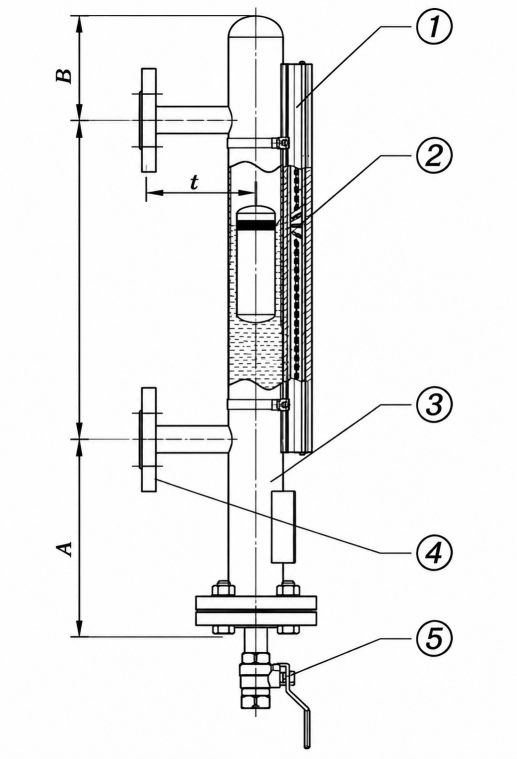
Indicator Assembly
Magnetic Float
Measuring Chamber (Main Tube)
Process Connecting Flange
Drain Valve
Magnetic Level Gauges are designed to operate under demanding industrial conditions, including high-temperature, high-pressure, high-viscosity, and highly corrosive environments.
With a wide measurement range, no blind spots within the specified measuring range, and clear visual indication, they offer the following advantages:
Wide Measurement Range: The measuring range is flexible and is not restricted by the height of the storage tank.
Clear and Direct Reading: The liquid level is clearly visible. The viewing angle can be adjusted according to the user's requirements.
Suitable for Pressure Vessels: Ideal for liquid level and interface measurement in pressure vessels. The instrument integrates local indication, remote transmission output, and control alarm functions.
Remote Monitoring and Alarm Functions: Can be equipped with remote indication and upper/lower limit alarm functions.
Simple Structure and Easy Maintenance: Features a straightforward design for convenient installation and maintenance.
Reliable and Safe Operation: The indicating mechanism is completely isolated from the measured medium, providing excellent sealing performance, high reliability, and safe operation.
Customizable Materials: Component materials can be customized according to actual operating conditions and customer requirements.
Magnetic Level Gauges are generally available in two installation configurations: side-mounted and top-mounted. The appropriate installation method should be selected according to the requirements of the actual measurement application.
The following installation precautions should be observed:
Vertical Installation: The instrument must be installed vertically to ensure that the magnetic float can move freely up and down inside the measuring chamber.
Proper Installation Location: The installation position should be away from the inlet and outlet connections of the process medium. This helps prevent rapid local fluid fluctuations from affecting measurement accuracy.
Avoid Magnetic Interference: Ferromagnetic materials should not be placed near the instrument. Iron wire must not be used for fastening, as this may interfere with the normal operation of the Magnetic Level Gauge.
Additional Support for Long Instruments: For Magnetic Level Gauges exceeding a certain length, intermediate reinforcing flanges or mounting lugs should be provided to improve structural strength and support the instrument's own weight.
Calibration After Installation: After installation, use a calibration magnet to guide the magnetic indicator flaps through one complete movement. The indication should be adjusted so that red is displayed below the zero level and white is displayed above the zero level.
The following table summarizes common operating problems, possible causes, and recommended troubleshooting methods.
| Possible Cause | Recommended Solution |
|---|---|
| The magnetic indicator flap clips are loose, or the flap positions have shifted, preventing normal rotation. | Check the clips and the positions of the indicator flaps. |
| The indicator flaps have become deformed due to excessive temperature. | Verify the actual operating temperature at the installation site. |
| The magnetic float is damaged or stuck. | Inspect the magnetic float and the inside of the main chamber for foreign matter or deposits. |
| The process medium has crystallized or frozen, preventing the float from moving. | Check whether there are any abnormalities in the production process. |
| Possible Cause | Recommended Solution |
|---|---|
| The sensing element inside the remote transmission unit is faulty. | Use a multimeter to check whether the sensing element has a resistance output. Also check whether the module provides a 4–20 mA current output. |
| The transmission module has malfunctioned. | Check whether the positive and negative power supply terminals are connected correctly and whether there is a current output. |
| Possible Cause / Influencing Factor | Recommended Solution |
|---|---|
| Iron filings or other contaminants have accumulated on the magnetic float, weakening its magnetic field or causing it to become stuck. | Remove the level gauge and take out the magnetic float. Clean off any attached contaminants. |
| The process medium has frozen or crystallized, preventing the float from moving. | Check whether there are any abnormalities in the production process. |
| The magnetic float is leaking or deformed. | Verify the corrosiveness of the process medium and the actual operating pressure. |
| The magnetic strength of the float has weakened. | Contact the manufacturer for technical consultation and a suitable solution. |
| The density of the process medium is inaccurate, causing the float to lose buoyancy. | Verify the actual density of the process medium. |
Magnetic Level Gauges offer a practical and reliable solution for industrial liquid level measurement. Their straightforward operating principle, clear visual indication, and adaptability to demanding process conditions make them suitable for a wide range of industrial applications.
Proper installation, appropriate material selection, and regular inspection are essential to maintaining measurement accuracy and ensuring long-term operational reliability.
When selecting a Magnetic Level Gauge, users should consider the process medium, operating temperature, operating pressure, medium density, corrosion conditions, and required measurement range to ensure that the instrument meets the actual application requirements.
Продолжайте читать, оставайтесь в курсе событий, подписывайтесь, и мы будем рады, если вы поделитесь с нами своим мнением.


Авторские права
@ 2026 ANHUI TIANKANG (GROUP) SHARES CO.,LTD. Все права защищены
. ПОДДЕРЖИВАЕМАЯ СЕТЬ
XML
политика конфиденциальности
Карта сайта
Электронная почта : overseasales@tiankang.com
Адрес : No.20 South Renhe Road,Tianchang,Anhui,P.R.C
Авторские права
@ 2026 ANHUI TIANKANG (GROUP) SHARES CO.,LTD. Все права защищены
.ПОДДЕРЖИВАЕМАЯ СЕТЬ
Оставить сообщение

 Русский
 English
 Français
 Español
 عربي